01 / DELPHI
An answer with its source attached
Current application interface. The question, answer, source excerpt, and relevance score are illustrative examples.
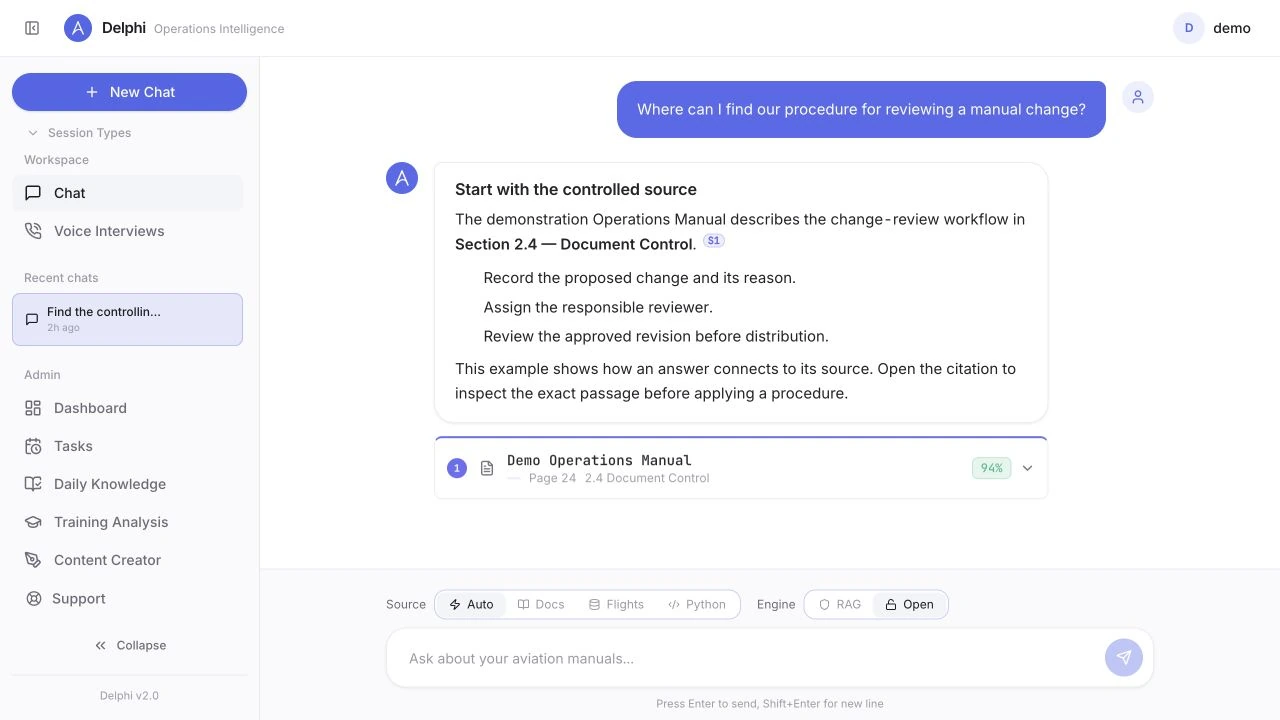
DELPHI brings aviation documents and connected operational information into a focused knowledge workspace. Move from a question to cited evidence, then keep the source in view as you work.
Email me the brochure (PDF · 3.4 MB)Explore the current product interface with demonstration data. Open any screenshot for a closer look.
Current application interface. The question, answer, source excerpt, and relevance score are illustrative examples.
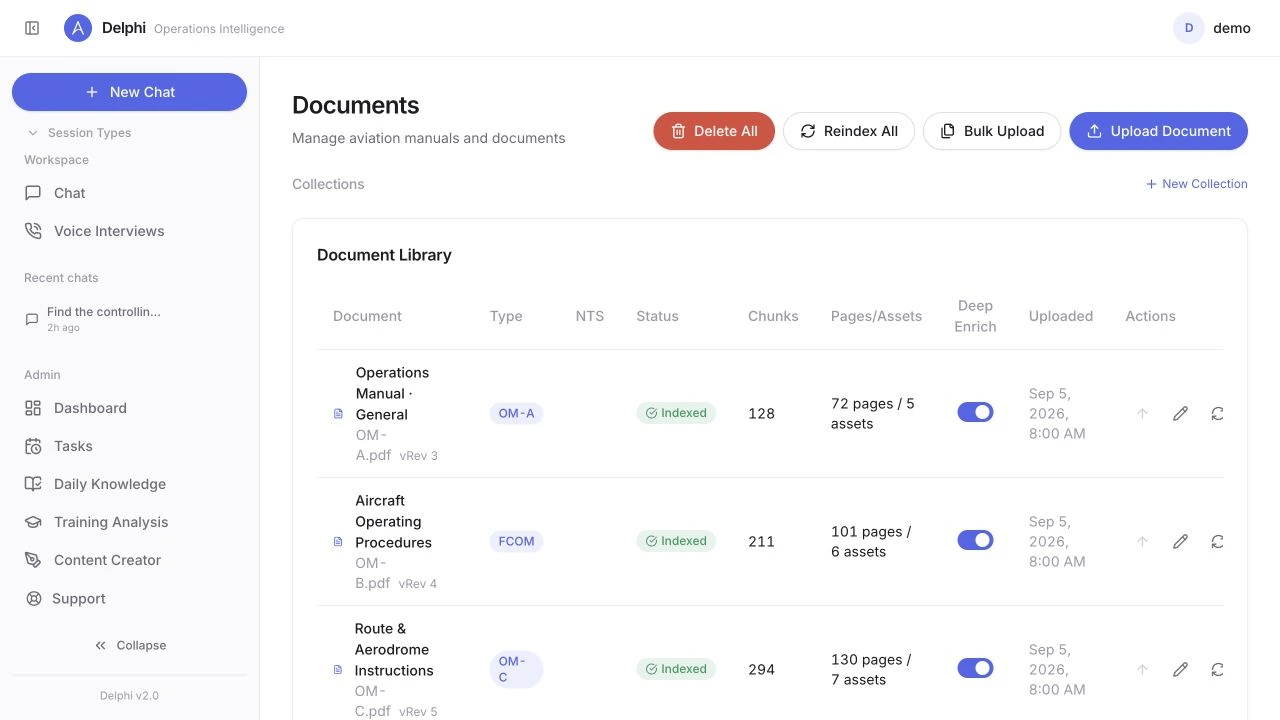
Manage versions, indexing, page assets, and enrichment in the document library.
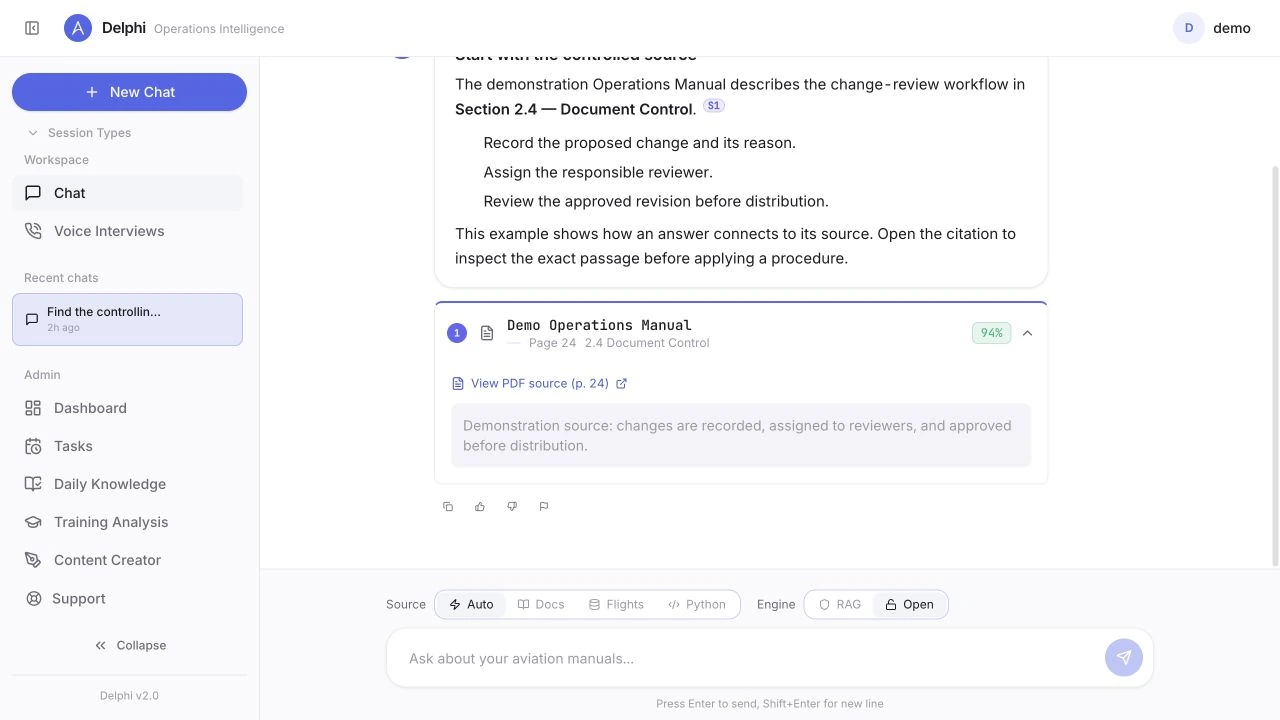
Expand the citation and move from the answer to the document source.
Cited answers, focused learning, training drafts, and operational intelligence.
Citations identify the source document, page, and available section context. Expand the supporting excerpt or open the document source to inspect what the answer drew on.
Ingest PDF, DOCX, PPTX, XLSX, PNG, and JPEG files. Manage document versions, effective dates, categories, collections, processing state, and indexing priorities.
Choose permitted documents for a focused session. Profiles and document or collection roles constrain the material a user can retrieve.
Learning mode supports guided exploration of aviation knowledge. Training workflows help instructors prepare content drafts for their own review.
A dedicated flight-operations mode queries configured operational data through structured tools. Bring source records and analytical context into the same conversation.
ISARP workflows help map requirements to document evidence and organize review. Human auditors remain responsible for applicability and the resulting assessment.
Configure scheduled reports and Daily Knowledge briefings, and inspect query insights to understand the questions teams ask and where content needs attention.
The opt-in Voice Interviews workflow supports approved question plans, consent gates, live supervision, transcript review, and a deliberate investigator-controlled evidence handoff.
DELPHI's value is the work around the answer: retrieval, source context, analysis tools, and a clear route back to the underlying material.
Aviation-aware chunking, document enrichment, and optional vision extraction make complex source material available to the retrieval pipeline.
Faithfulness checking evaluates whether cited passages support answer claims. Its results are an additional review signal, not a guarantee of correctness.
Training outputs remain drafts. Safety voice plans require approval and consent; completed transcripts enter an investigation only after explicit investigator review.
Agree a representative sample and a baseline from your current process. These are proposed evaluation measures, not published performance results.
Approved manuals with conflicting revisions and difficult or unanswerable questions.
Check sources, permissions, controlling versions, and unsupported answers.
Citation support; revision correctness; unsupported answers; time to verify.
No. DELPHI has its own document library, access controls, conversations, and administrative workspace. Connections to other FlightAtom products are configured for the workflows the operator needs.
Yes. Citation cards show the source document and available page or section context. You can expand the supporting excerpt and open the source document.
DELPHI supports PDF, DOCX, PPTX, XLSX, PNG, and JPEG files. Administrators manage document metadata, access, processing, and indexing.
No. The opt-in workflow collects a factual account under an approved plan and consent process. The initiating investigator reviews the effective transcript before appending it as source evidence; that handoff does not generate findings.
A focused walkthrough, with the people and decisions that matter to your team.