01 / PINAX
Know where the day stands
See the operating-day summary, flight progress, and punctuality context on the shared wallboard.
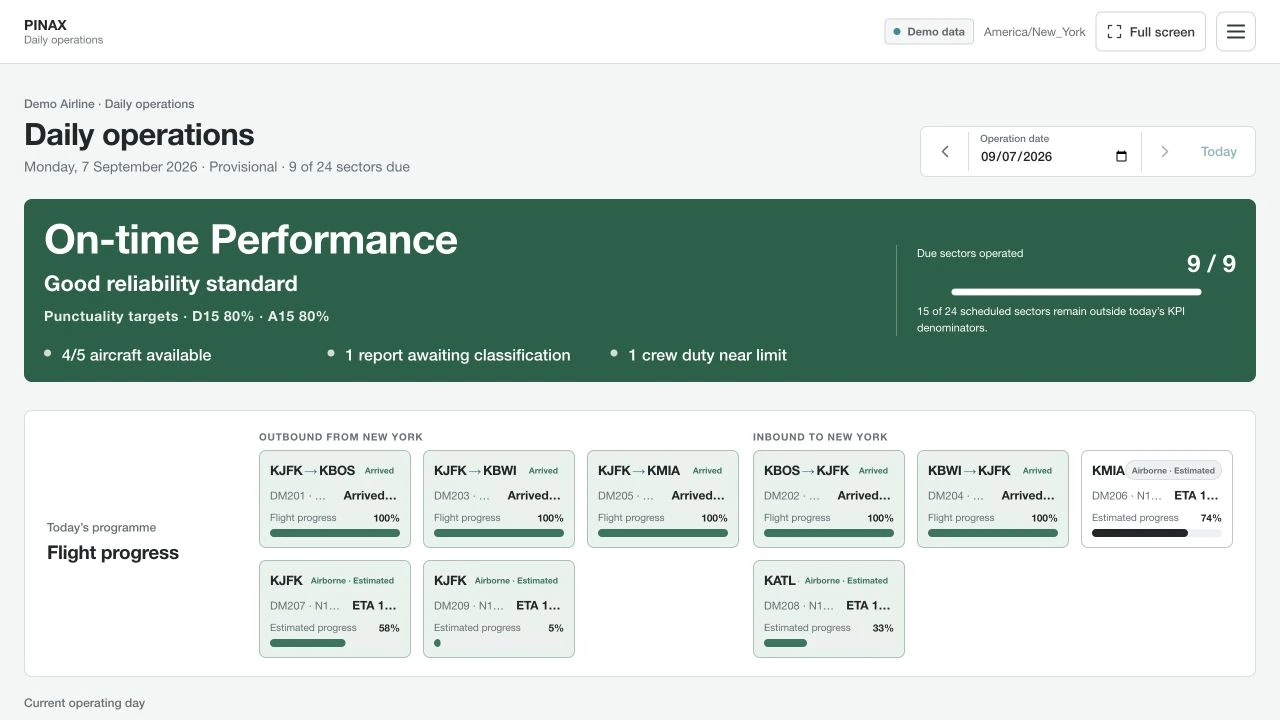
Put the operating day, flight progress, punctuality and delay causes in one view, then move into historical analysis and management briefs.
Email me the brochure (PDF · 4.0 MB)Explore the current product interface with demonstration data. Open any screenshot for a closer look.
See the operating-day summary, flight progress, and punctuality context on the shared wallboard.
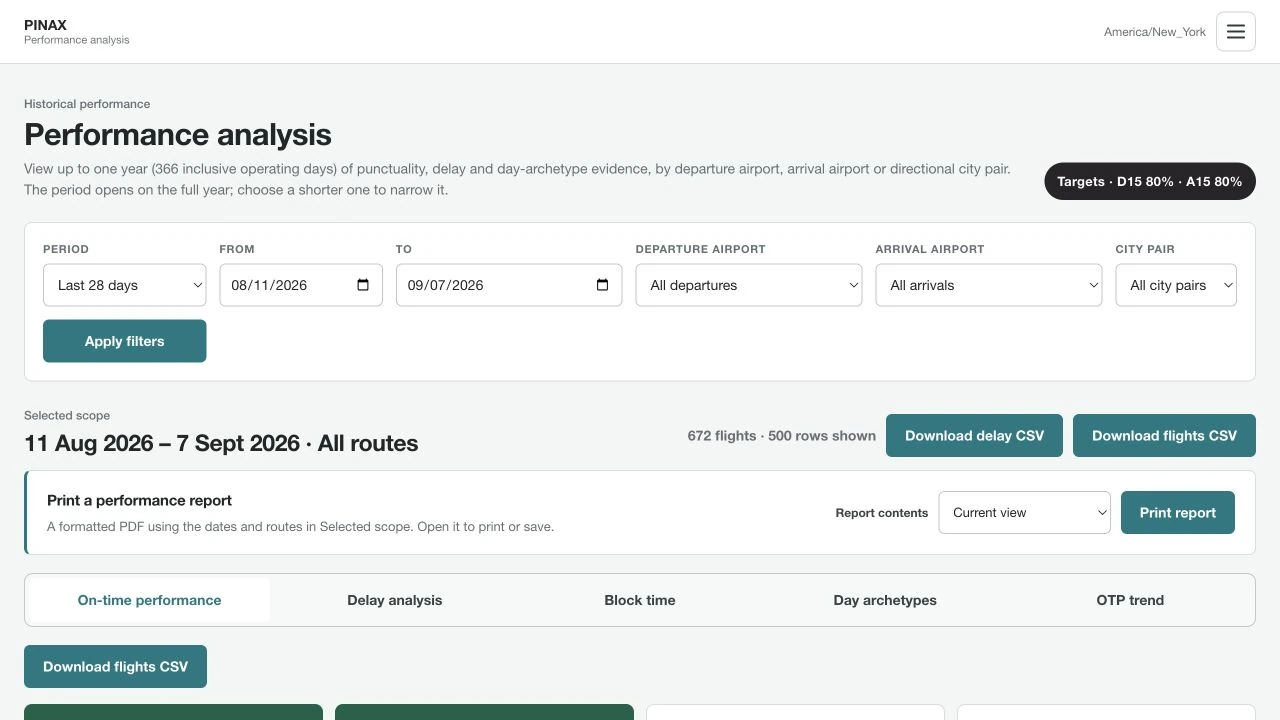
Select dates, airports, and directional city pairs, then review the performance and export the supporting records.
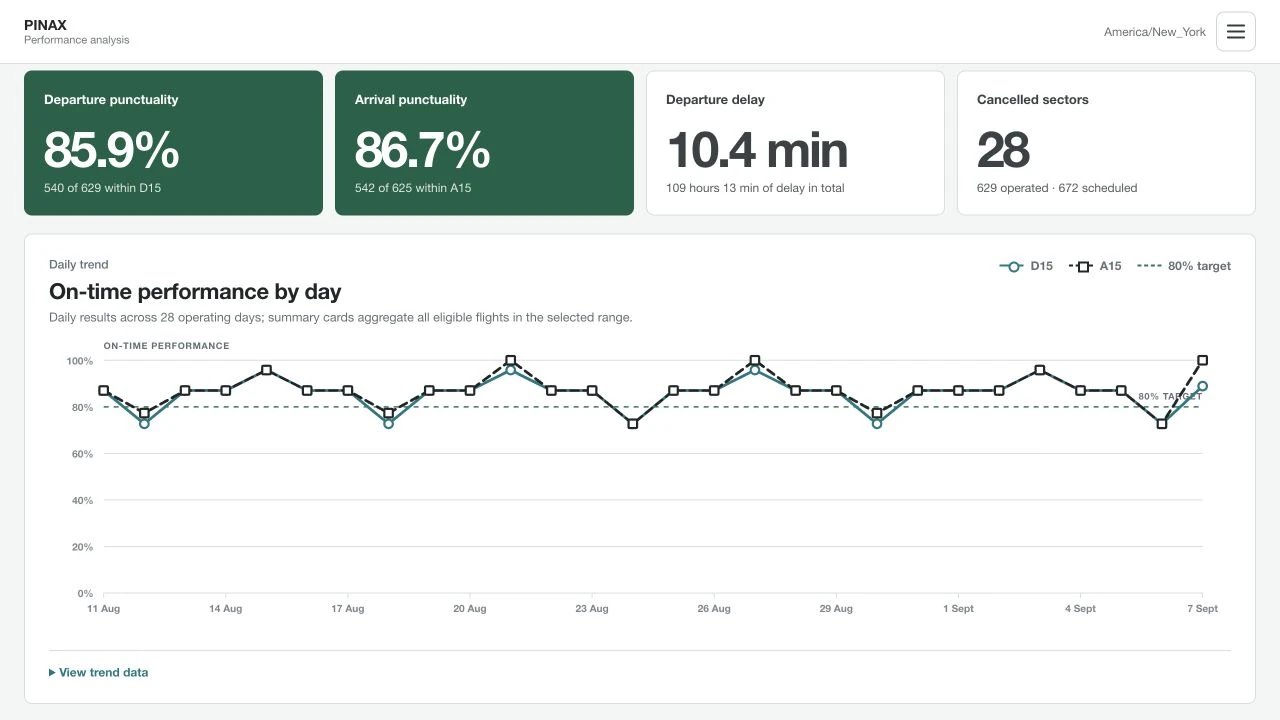
Inspect on-time departure and arrival trends across the selected period and compare them with the displayed target.
Put the operating day, flight progress, punctuality and delay causes in one view, then move into historical analysis and management briefs.
Bring the published programme, due-sector completion, operating verdict and current flight progress into one daily wallboard.
Review D15 and A15 alongside their eligible-flight denominators, delay per sector and the stated management targets.
Move from the summary to flight-level schedule, aircraft, status and OUT/OFF/ON/IN timing evidence.
Filter historical performance by date range, departure airport, arrival airport or directional city pair.
Explore delay causes and their contribution to the selected operating scope, with CSV exports for further review.
Compare block-time evidence and day archetypes to investigate recurring performance patterns.
Use weighted historical trends with explicit data and fit limits to see the direction of performance.
Generate a daily PDF brief and supporting reports from the validated operational dataset, with a separate provisional forward look.
Distinguish the operational authority, live position refinements, estimates, stale inputs and unavailable supporting data.
PINAX turns operational records into transparent measures, patterns and management context.
The same operating records support the daily view and historical calculations. Summary percentages retain their eligible-flight denominators.
Trend calculations use historical observations and expose limited evidence instead of presenting a projection as a certain outcome.
The connected feed remains the operational authority. Position refinements and forward-looking context retain their own source and availability boundaries.
Agree a representative sample and a baseline from your current process. These are proposed evaluation measures, not published performance results.
An operating period with a known source and a specific punctuality question.
Trace the denominator, inspect flights, and prepare a management brief.
Report preparation time; source coverage; agreement with independently calculated metrics.
No. PINAX is a standalone daily operations and performance application.
The supplied implementation uses myairops as its operational authority, retains a separate ForeFlight provider and supports optional Flightradar24 position refinement under a configured data agreement.
Yes. Its analysis view supports date ranges, departure and arrival airports, directional city pairs, punctuality, delay attribution, block time and operating-day patterns.
No. Management briefs and provisional forward looks support operational review. They do not constitute a dispatch release.
Its current operational measures, reports and statistical trends are deterministic analyses. The product does not require a generative assistant to calculate those results.
A focused walkthrough, with the people and decisions that matter to your team.