Crew Planning

Airline crew scheduling software for lean operations teams

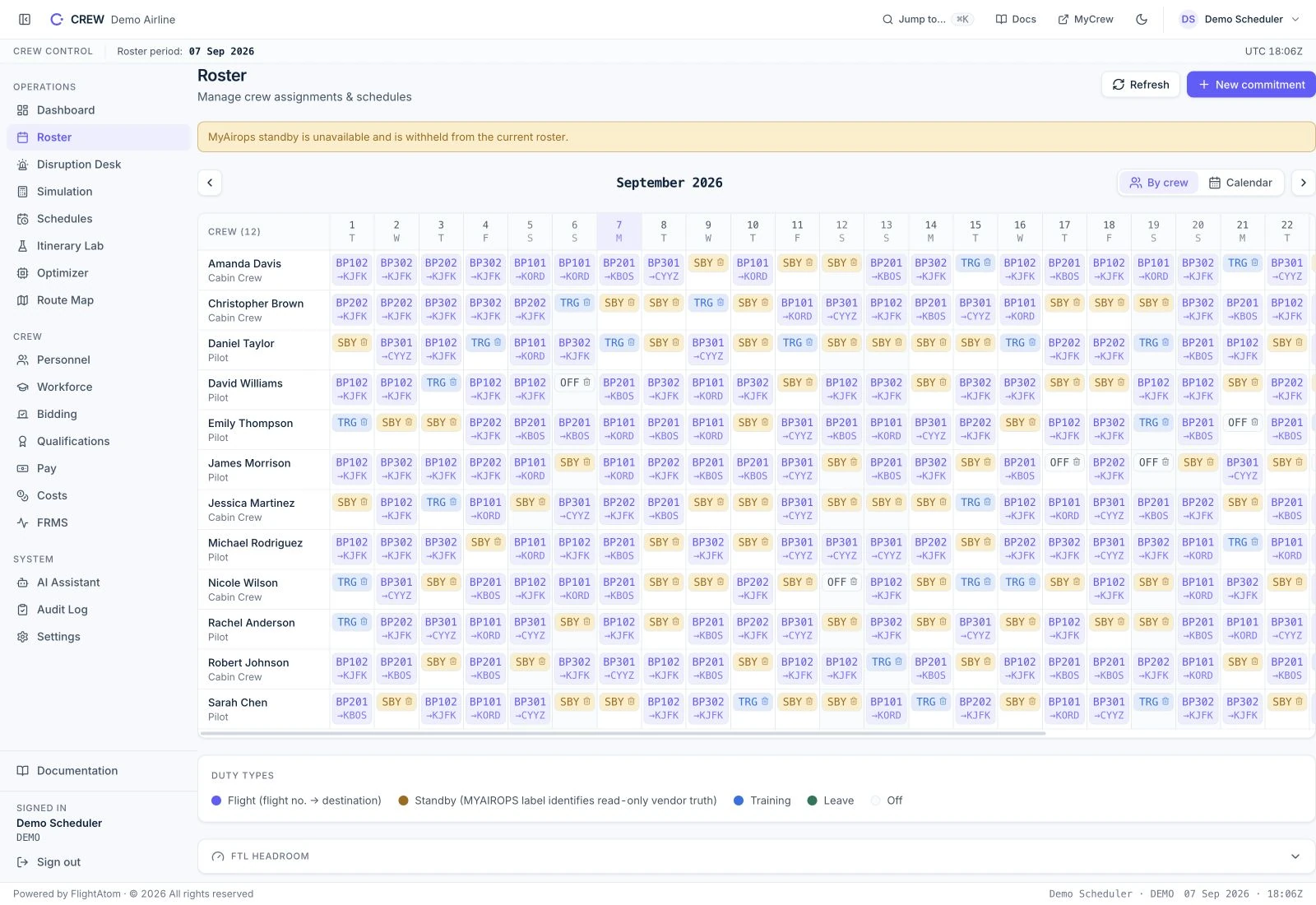
Airline crew scheduling software helps authorized planning teams build, adjust, publish, and monitor rosters. FlightAtom CREW brings reserves, qualification readiness, configured duty and fatigue context, bids, and disruption review into one operator-scoped workflow.

Published by FlightAtom · Last updated 19 July 2026 · Read the airline software evaluation guide

Built for the pressure points in airline crew planning

Crew teams need fast answers when sickness, reserve availability, training requirements, fatigue risk, and disruption recovery all collide. FlightAtom gives planners a single operational view before the schedule reaches the crew member.

Roster review

Review candidate rosters against available duty, availability, qualification, and absence data before publishing changes.

Reserve coverage

Present base, qualification, configured duty-rule, fatigue, and disruption indicators when planners compare candidate reserve assignments.

Fatigue risk signals

Surface configured duty and group-level fatigue indicators for authorized review.

From static roster to source-aware operating picture

Where connected, FlightAtom CREW can bring scheduling decisions together with training, operations, and configured rule context for planner review.

  • Duty-rule awarenessPresent configured local-rule, policy, agreement, and FRMS context for authorized review of changes.
  • Mobile crew updatesWhere enabled, publish approved schedule changes and operational instructions with source-dependent update timing.
  • Operational contextWhere integrated, compare crew availability with delays, aircraft swaps, recorded training expirations, and OCC priorities.
  • Reviewable historyPreserve supported schedule decisions, overrides, and notifications for review.

Crew scheduling capabilities in depth

FlightAtom CREW is the add-on behind this airline crew scheduling software solution. It connects the personal crew view, the planner workspace, and schedule oversight. Configured signals support each decision, and authorized people approve the change.

  • Personal duty visibilityGive crew members a personal dashboard for upcoming duties, readiness status, and attention items, with published roster detail covering duty timing, legs, position, and pairing detail.
  • Roster controlBuild and adjust assignments and coverage in a planner workspace connected to schedule, readiness, bid, and configured-constraint views.
  • Qualification readinessReview configured qualification, medical, training, and recency records with current and attention states alongside planning activity. These states are decision support, not certification.
  • Bid and publication workflowCollect supported crew preferences and review them with coverage and rule context. Publication stays under authorized planning control, and a submitted preference is not a guaranteed award.
  • Disruption recoveryCompare affected duties and supported recovery options in one workspace; an authorized planner confirms any reassignment before it is applied.
  • Workforce outlookInvestigate staffing demand, available supply, and schedule state across the planning horizon so planning teams can act on pressure early.

Data inputs and integrations

Scheduling quality depends on the data feeding it. For each rollout the integration scope is defined explicitly: the authoritative source, refresh timing, conflict handling, and fallback behavior for every input, with feasibility, security, source authority, and maintenance boundaries validated per connection.

Scheduling inputs

Typical inputs include the flight schedule, crew records, qualifications, recency, training status, availability, leave, assignments, bases, and configured duty or fatigue context.

Connected systems

FlightAtom can scope supported connections to crew, training, operations, and HR systems, including legacy crew management and third-party scheduling tools.

FlightAtom add-ons

Where connected, CREW works alongside TRAINING for recurrent training and qualification evidence, and OPS for day-of-operations context such as delays and aircraft swaps.

How to evaluate airline crew scheduling software

Structure the comparison around the decision, not the demo. The airline operations software evaluation guide describes six criteria for evaluating airline software; the ones below matter most for crew scheduling.

  • Workflow authorityName the accountable planner role, the approval point, the override path, and the system of record for the roster before discussing automation.
  • Source authorityIdentify the owner, refresh timing, and stale-data behavior for every input, including crew records, qualifications, availability, and the flight schedule.
  • Decision methodSeparate deterministic duty-rule checks, optimization, and analytics instead of calling all of them “AI”; each needs its own validation and approval model.
  • Evidence and traceabilityConfirm a reviewer can reconstruct a schedule decision from preserved records: the change, the override, the notification, and the authorized approval.
  • Rollout and validationScope roles, fleets, bases, configured rules, and test cases for the first release, and validate them before operational use.

Pricing

FlightAtom doesn’t publish list pricing. Contact sales for a quote scoped to your operation. CREW is a connected add-on for Aurora, FlightAtom’s core platform, and the exact data and workflow connections are configured for each operation. Request a demo to see CREW connected to Aurora.

Airline crew scheduling FAQs

What is airline crew scheduling software?

Airline crew scheduling software helps authorized planning teams build, adjust, publish, and monitor rosters while keeping configured duty-rule signals, reserves, qualifications, and fatigue context visible for review.

Does FlightAtom support FRMS workflows?

CREW can support configured FRMS-related planning views, including duty-time context, reserve pressure, and group-level fatigue indicators. It does not certify an FRMS or determine fitness for duty; operators validate the applicable inputs, rules, and decisions.

Can it integrate with existing airline systems?

FlightAtom can scope supported connections to crew, training, operations, and HR systems. Feasibility, security, source authority, and maintenance boundaries are validated for each integration.

Does FlightAtom CREW produce pairings or rosters?

FlightAtom CREW is presented as a roster, readiness, publication, and disruption-review workspace. Any pairing-generation or optimization scope must be confirmed during implementation; the product should not be assumed to replace an existing pairing optimizer unless that capability and its validation are explicitly included.

Are crew bid preferences guaranteed?

No. Crew members can record supported preferences and planners can review them with coverage and rule context in the bid and publication workflow, but a submitted preference is not a guaranteed award. Coverage needs, configured rules, qualifications, agreements, and authorized planning judgment determine the final roster.

How does disruption recovery stay under human control?

CREW can bring affected duties, candidate changes, and configured operational context into a recovery workspace so authorized planners can compare options. Suggested or ranked options require human review and confirmation before a reassignment is applied; the platform does not hold autonomous authority to reassign crew.

Does CREW certify roster legality or fitness for duty?

No. CREW can present configured duty-rule, qualification, recency, and fatigue context for authorized review. The operator remains responsible for source completeness, applicable rules, approved procedures, roster legality, fitness-for-duty processes, and final operational approval.

Which duty-time and fatigue rules can be configured?

Applicable flight-time limitations, fatigue-risk inputs, agreements, and internal planning rules are mapped for each operator. FlightAtom does not claim universal coverage of every FAA, EASA, OTAR, contractual, or local rule set; the configured rules and test cases must be validated before operational use.

What data does crew scheduling software need?

Typical inputs can include the flight schedule, crew records, qualifications, recency, training status, availability, leave, assignments, bases, and configured duty or fatigue context. The authoritative source, refresh timing, conflict handling, and fallback behavior for every input are defined during integration scoping.

Official rule context for evaluation

Use the applicable authority material and the operator’s approved manuals when defining configuration and acceptance tests. For context, review 14 CFR Part 117 and EASA’s Easy Access Rules for Air Operations. These links do not imply certification or complete rule coverage.