01 / PHAROS
Start with what happened
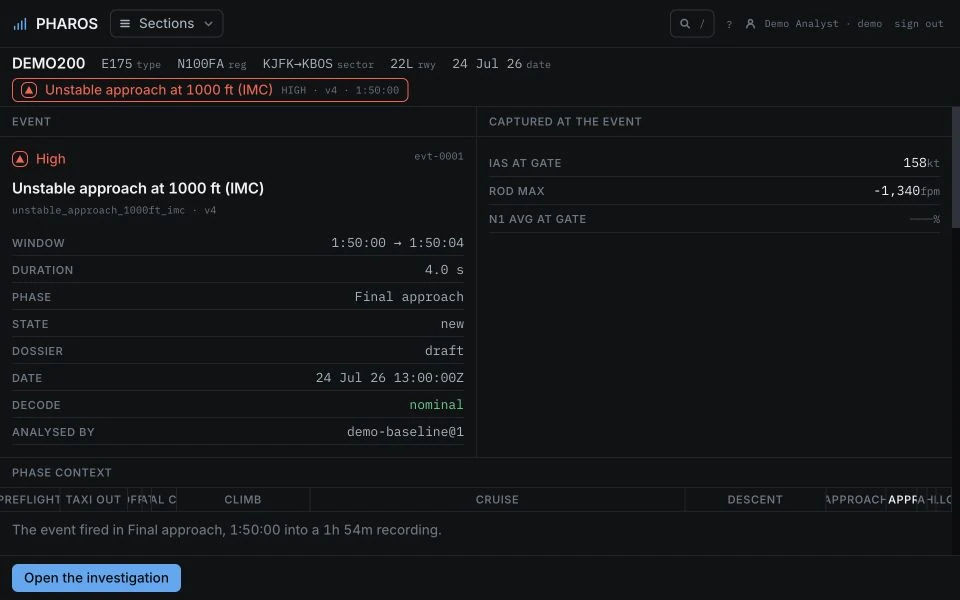
The event summary identifies an unstable approach during final approach. It places the event window, review status, recorded airspeed and descent rate together, with links back to their source samples.
PHAROS is a flight-data monitoring product in development. It brings recorder ingestion, event review, trace analysis and evidence-grounded assistance into an analyst workspace built around reproducibility and crew privacy.
Follow one synthetic unstable-approach example: identify the event, inspect the recorded traces, then review the investigation draft. PHAROS is in development; these are demonstration records.
The event summary identifies an unstable approach during final approach. It places the event window, review status, recorded airspeed and descent rate together, with links back to their source samples.
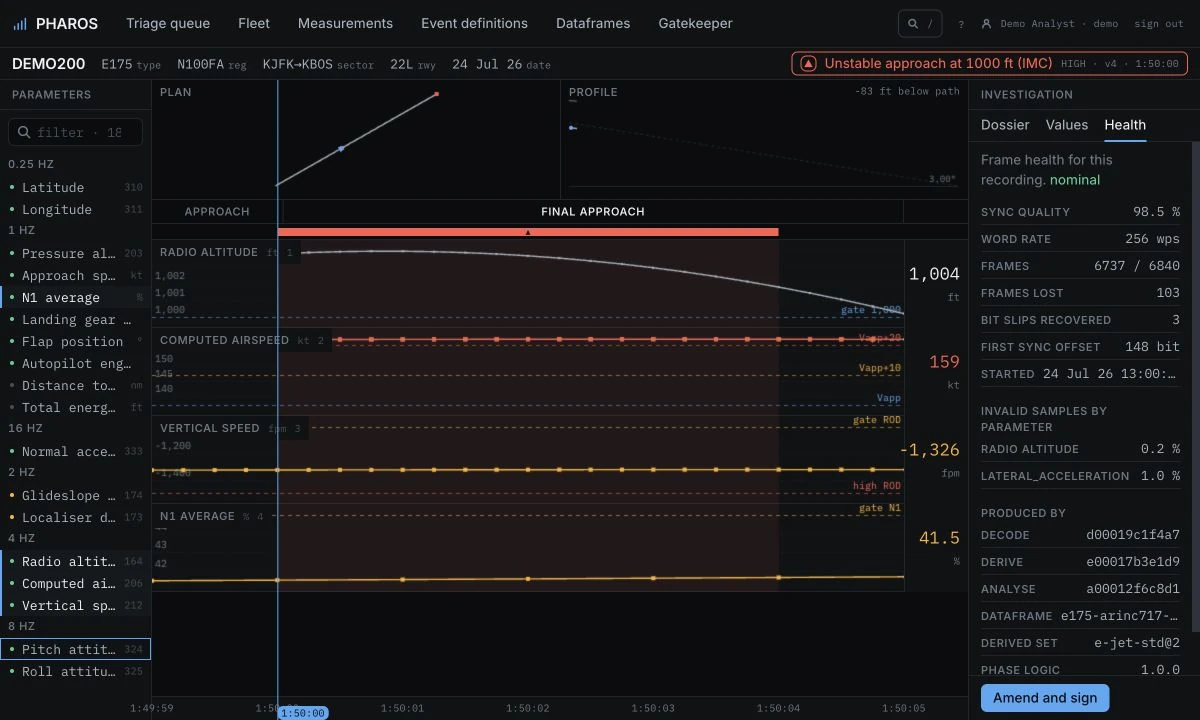
Follow altitude, airspeed, descent rate and engine power at the same instant. The shaded event window and reference lines give the traces context; the health panel keeps recording quality visible.
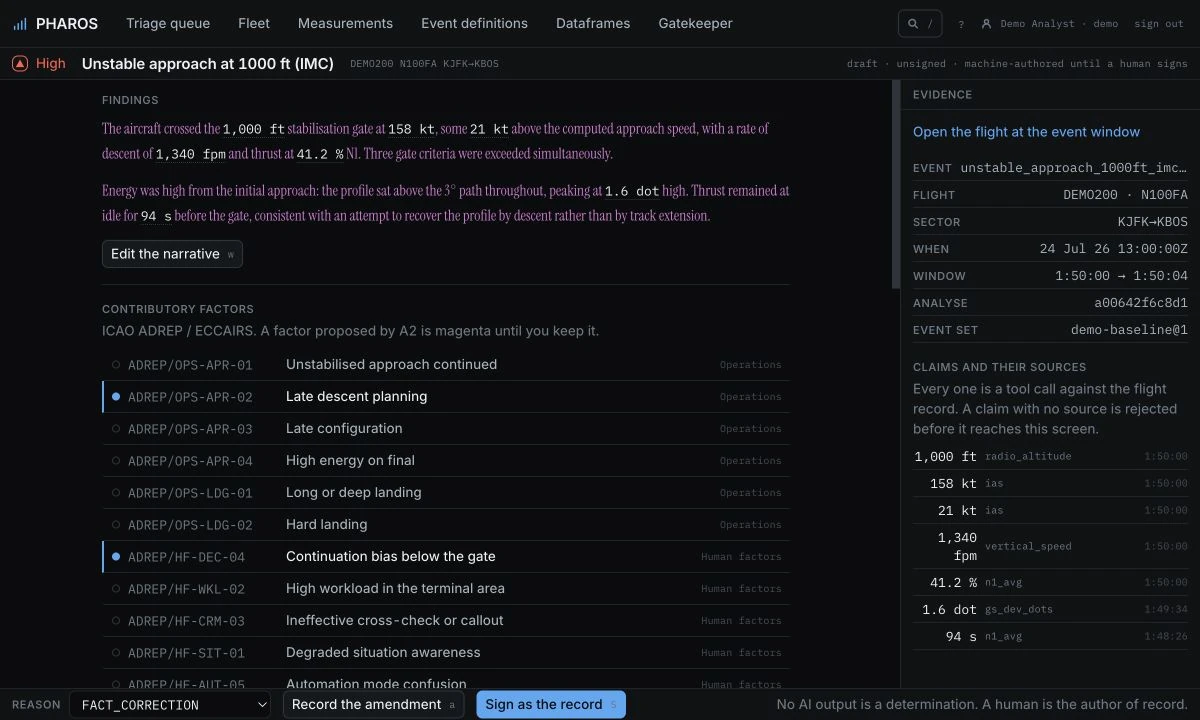
Read the draft findings beside the flight evidence and contributing factors. The record remains explicitly draft and unsigned until an analyst reviews it and signs.
Flight-data monitoring and investigation assistance, in development with traceable evidence and crew privacy controls.
Track raw-file custody, duplicate detection, quarantine and tail resolution before data enters the decoding pipeline.
Carry decoder, dataframe, derived-parameter and event-definition versions with the output so an analyst can follow how a result was produced.
Review severity, flight phase and disposition in the triage queue, with decode gaps separated from operational events.
Inspect parameter traces, approach profile and plan view around an event, with sample validity and source context visible together.
Bring grounded narrative, contributing factors, risk classification and proposed actions into a dossier for analyst amendment and sign-off.
Edit event and dataframe definitions, compare backtest results and require a second-person review before promoting an event set.
Explore decode coverage, ingestion outcomes, safety indicators and event distributions alongside investigation workload.
Separate de-identified analytics from identity records and use governed access workflows when an authorized re-identification is required.
The implemented AI layer supports an analyst's workflow and is controlled separately from conventional flight-data processing.
Use confidence-scored triage and similar-event retrieval to direct attention. Triage never auto-closes events and is not applied to high-severity events.
Build a dossier from bounded tools and cited flight evidence. The analyst can amend the draft and must sign the investigation.
Gate enablement on evaluation results and use tenant kill switches. The conventional FDM workflow is designed to continue with AI disabled.
Agree a representative sample and a baseline from your current process. These are proposed evaluation measures, not published performance results.
Synthetic fixtures and independent reference decodes for an agreed aircraft layout.
Inspect provenance, event definitions, synchronized traces, and analyst review.
Decode agreement; event detection errors; data-quality coverage.
PHAROS is in development. Its current implementation supports demonstration and validation work, while aircraft layouts, thresholds and outputs require operator and independent reference validation before operational use.
PHAROS has its own analyst interface and processing pipeline. Safety-system integration is a programme requirement to define with the operator; Aurora is one possible connected product.
The implemented AI layer covers triage assistance, grounded dossier drafts, constrained natural-language queries and similarity. Analysts retain review and sign-off responsibility.
A focused walkthrough, with the people and decisions that matter to your team.